
Through one of my group life-coaching sessions, there was an interesting concept that I came up with.
During times of conflict, it’s exceptionally difficult to find one’s center. One’s True North. When we operate from (near-)extremes, it’s almost impossible to find a middle ground. It’s the typical “us versus them” mentality. A zero-sum game where in the long run nobody wins – we all end up suffering in some way, shape or form.
It occurred to me that it’s hard to measure any sort of progress during a conflict because we don’t know where to orient ourselves (other than at extremities) to what’s going on around us. During this disorientation, it becomes exceptionally difficult to rationalize what is happening and sometimes we (perhaps more often than we care to admit) end up adding more fuel to the fire.
I thought the concept of this diagram could help with finding that center amongst all the conflict.
We’ll start with some basic ideas, namely:
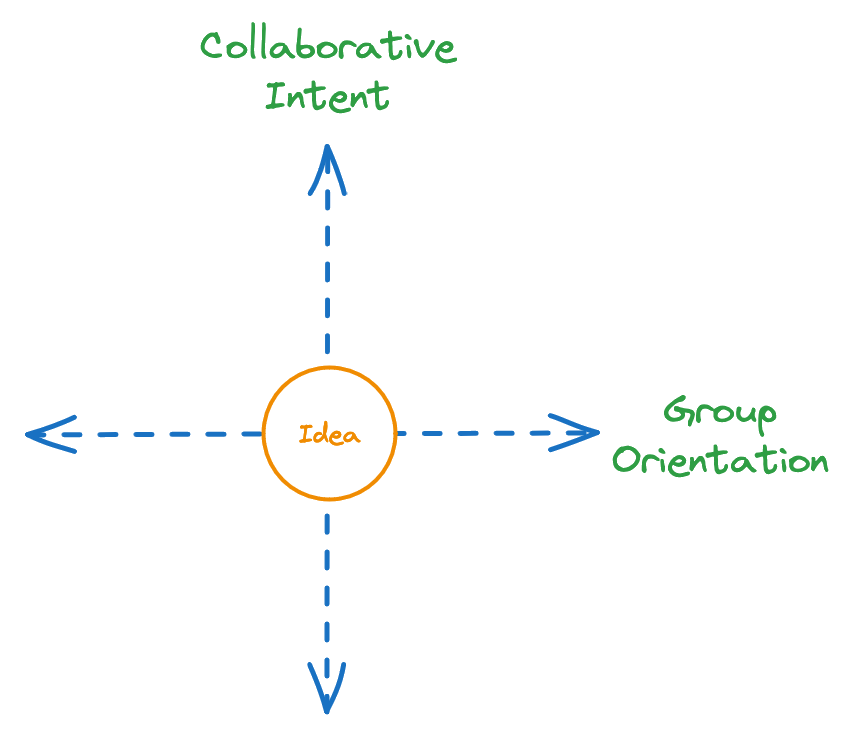
- On the X-axis we have the Group Orientation. Group orientation means that you are either for or against an idea.
- On the Y-axis we have the Collaborative Intent. Collaborative Intent implies if we are working for the idea or against the idea.
- Right in the middle, we have the idea or topic that we’re trying to discern ourselves from.
An idea could be anything from something as simple as:
- Eating Person B’s food
- Taking away person A’s land
- Restricting Group A’s freedom
- Disrespecting Country A’s autonomy.
- etc.
Now let’s expand this concept by adding some more details to each axis.
- On the X-axis, we have our 2 groups:
- Group A has one side/view of the idea.
- Group B has the other opposing side/view of the same idea.
- On the Y-axis, it’s broken down into 2 areas, namely:
- Synergistic Collaboration – This is where ideally we want both parties to be moving towards. When both groups are in this space, they are progressing each of their agendas that align with the common idea.
- Counterproductive Sabotage – This is a place where both parties would want to avoid as it would be detrimental to both sides and playing into the zero-sum game as mentioned earlier and would result in a downward spiral of the idea.
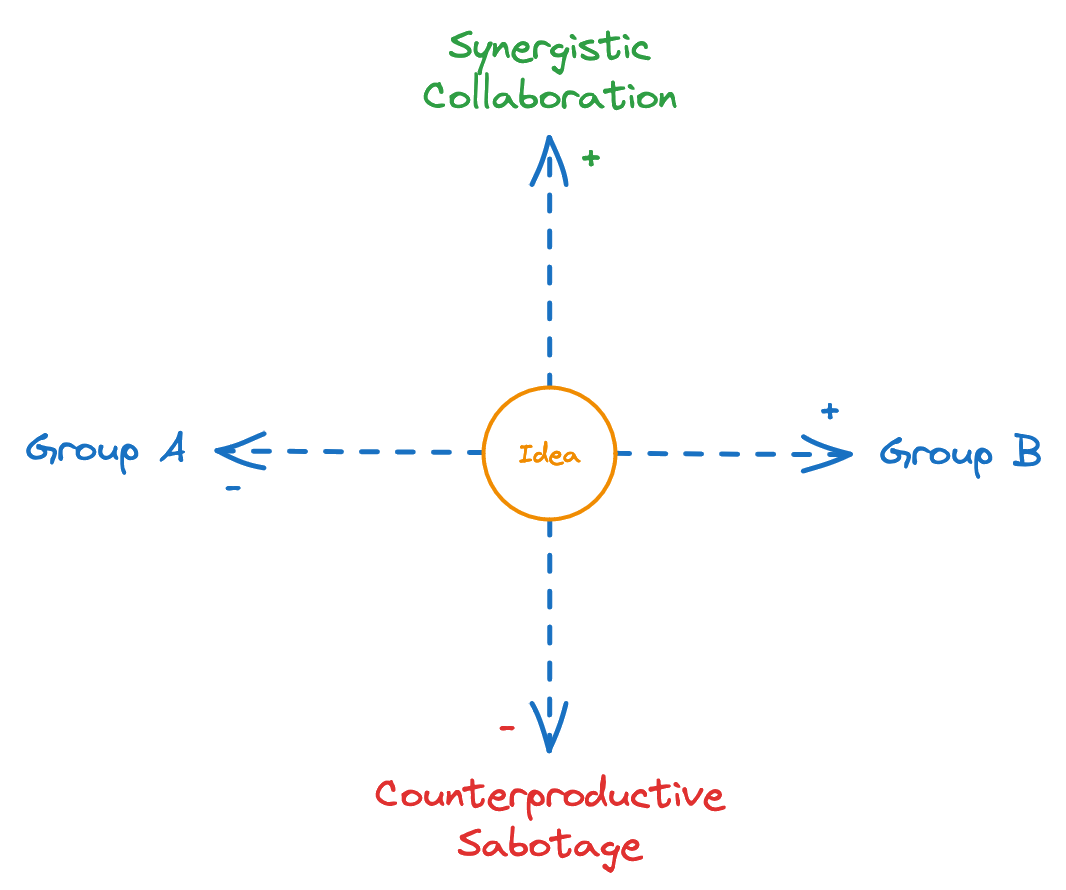
The idea with this diagram is to provide a visual representation as to where Group A and Group B are based on the idea that they’re working towards.
At the beginning of a conflict, both sides would ask themselves each a series of questions that allow them to position within the graph.
As time follows on, the same or more evolving set of questions could be asked that would allow them to plot themselves on the graph.
The goal is to get both Group A and Group B moving towards the center, but in terms of the idea, moving forward in a Synergistic Collaboration way (upwards).
To determine where in the graph one should be aligned, answer the questions below and take the average across all of the questions.
Here are some questions to start:
Questions along the X-Axis (Group Orientation)
- Alignment with Group’s Objectives:
- How well do your group’s objectives align with the common goal?
- Group A: (-1: Well aligned, -5: Not aligned at all)
- Group B: (1: Not aligned at all, 5: Well aligned)
- How well do your group’s objectives align with the common goal?
- Understanding of the Opposing Group’s Perspectives:
- How well do you understand the perspectives and objectives of the opposing group?
- Group A: (-1: Very well, -5: Not at all)
- Group B: (1: Not at all, 5: Very well)
- How well do you understand the perspectives and objectives of the opposing group?
- Willingness to Acknowledge Differences:
- How willing is your group to acknowledge and discuss differences with the opposing group?
- Group A: (-1: Very willing, -5: Not willing at all)
- Group B: (1: Not willing at all, 5: Very willing)
- How willing is your group to acknowledge and discuss differences with the opposing group?
- Flexibility in Approach:
- How flexible is your group in adapting its approaches considering the opposing group’s feedback?
- Group A: (-1: Very flexible, -5: Not flexible)
- Group B: (1: Not flexible, 5: Very flexible)
- How flexible is your group in adapting its approaches considering the opposing group’s feedback?
- Engagement in Open Dialogue:
- How much does your group engage in open dialogue with the opposing group?
- Group A: (-1: Frequently, -5: Rarely)
- Group B: (1: Rarely, 5: Frequently)
- How much does your group engage in open dialogue with the opposing group?
Questions along the Y-Axis (Collaborative Intent)
- Efforts in Building Trust:
- How much effort is your group putting into building trust with the opposing group?
- Group A: (-1: Significant effort, -5: No effort)
- Group B: (1: No effort, 5: Significant effort)
- How much effort is your group putting into building trust with the opposing group?
- Prioritization of Collective Success:
- How much does your group prioritize collective success over individual group success?
- Group A: (-1: Highly prioritize, -5: Do not prioritize)
- Group B: (1: Do not prioritize, 5: Highly prioritize)
- How much does your group prioritize collective success over individual group success?
- Contributions to a Positive Atmosphere:
- How much do you believe your group contributes to creating a positive and collaborative atmosphere?
- Group A: (-1: Contributes a lot, -5: Does not contribute)
- Group B: (1: Does not contribute, 5: Contributes a lot)
- How much do you believe your group contributes to creating a positive and collaborative atmosphere?
- Commitment to Resolving Disputes:
- How committed is your group to resolving disputes and disagreements constructively?
- Group A: (-1: Highly committed, -5: Not committed)
- Group B: (1: Not committed, 5: Highly committed)
- How committed is your group to resolving disputes and disagreements constructively?
- Adaptability to New Ideas and Solutions:
- How adaptable is your group to incorporating new ideas and solutions from the opposing group?
- Group A: (-1: Highly adaptable, -5: Not adaptable)
- Group B: (1: Not adaptable, 5: Highly adaptable)
- How adaptable is your group to incorporating new ideas and solutions from the opposing group?
Once we’ve figured out where in the graph each person/group lies, we can then start unpacking what are the structures/systems that position them

